
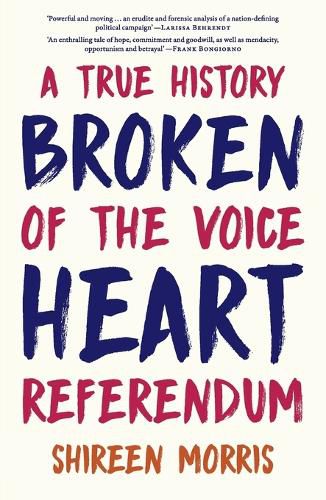
I was crushed by the defeat of the Voice referendum, appalled that such a simple request would be rebuffed by so many people through fear and -although no one wanted to own it – racism. No wonder First Peoples kept silent immediately afterwards, because the implications were just too awful. I can’t imagine how the people who had been the ‘face’ of the Yes case felt. Broken Heart by Shireen Morris tells us.
Shireen Morris starts off by explaining her own position: neither Indigenous nor white. She is of Indian Fijian ancestry, the daughter of parents who migrated to Australia in the 1970s. This placed her in an ambiguous position. It was a political reality that the Indigenous 3% minority would need supporters and the advocates from the 97% for the referendum to pass, and somehow the white constitutional lawyers and advisers, seemed revered and respected. But as a non-white ally, she was often accused of being ‘not blak’.
She is a constitutional lawyer, whose primary focus under the mentorship of Noel Pearson and the Cape York Institute over the previous 12 years had been Indigenous constitutional recognition. Now, I’m no great fan of Noel Pearson, I must admit. I find his Old Testament Prophet, hectoring tone abrasive, and his alignment with right wing politicians off-putting. However, in relation to referenda (referendums?) they will only pass with bipartisanship, and the referendum often has to be introduced by the party less ideologically likely to do so. For example, the much-vaunted 1967 referendum was introduced and carried by the Liberal Party, and the neo-liberal economic reforms of the 1980s could only have been introduced by a Labor party. It would have been far better (albeit rather galling as far as Labor voters are concerned) if constitutional recognition had been introduced by the Liberal Party. But as Morris showed in her previous book Radical Heart, once the then-prime minister Malcolm Turnbull rejected the Voice proposal in October 2017, there was little hope of bipartisanship. There was only ever bipartisanship for an amorphous and wholly symbolic form of recognition, and that proposal was explicitly and firmly rejected by Indigenous people. There were four choices: 1. accept a symbolic statement which would be rejected by Aboriginal people 2. wait for bipartisanship- but when, if ever, would that happen? 3. Abandon all hope 4. Try to win it without Bipartisanship. They went for the fourth option.
Noel Pearson and the Cape York Institute promote the idea of the Radical Centre:
Finding the radical centre requires engagement across divides, in contrast to the entrenched ideological positions and point-scoring of ordinary partisan politics. It is not simply about splitting the difference between two opposing principles to reach a lowest-common denominator. Rather, it is about harnessing the ‘dialectical tension’ in enduring disagreements to uncover a creative and ambitious reform solution… A thesis is proposed, which attracts a counterargument, the antithesis. The radical centre endeavours to synthesise these contradictory insights into a richer truth or a more correct and consensus-building position….The radical centre thus eschews simplistic categories like left and right. Finding it is an empathetic endeavour, requiring us to see the humanity and intelligence in our opponents and the kernels of truth in their opinions. (p. 26)
This is where Pearson and Morris aimed their activities, but there’s not much evidence of it here. People changed sides, allies became opponents, people lied. I wonder if they still have faith in the Radical Centre.
The book starts with a timeline, starting in 2012 through to the referendum on 14 October, when 40% voted ‘yes’ and approximately 60% voted ‘no’. It wasn’t always that way: there was around 60% support at first until mid-2023. There were many meetings and several drafts, and the accusation by the Coalition that Albanese presented it as ‘my way or the highway’ was just not true. There were many, many compromises but never from the Coalition. In retrospect, Morris thinks that they gave ground too early, which left them no where to go.
In 2014 Peter Craven, Julian Leeser, Damian Freeman and constitutional lawyer Ann Twomey proposed a constitutionally guaranteed Indigenous body to provide ‘advice to the Parliament and the Executive Government on matters relating to’ Indigenous people. Yet, at various times, all except Twomey distanced themselves from this initial suggestion. Frank Brennan opposed it from the start- he only wanted symbolic constitutional recognition. Others flip-flopped: Turnbull said yes, but with equivocation and probably did more damage by giving people reasons to vote no when he voiced his misgivings. Peter Craven seemed to live up to his name. Julian Leeser was a co-creator and longtime supporter of the Voice but then he recommended gutting the advice-giving aspect of it. But at least he had the courage of his convictions to resign his position. Morris dubs him ‘a noble politician’ for standing up for what he believed in, notwithstanding negative career ramifications. Given Leeser’s equivocation, I think she’s giving him a free pass. Ex-ministers Cheney, Peter Baume and Ken Wyatt declared that they would vote ‘yes’, and finally Leeser switched to genuine advocacy, along with Andrew Gee and Brigid Archer.
As far as Albanese is concerned, Morris claims that he committed the first error when announcing the referendum at the Garma festival without include the title of the law that was being proposed (I reckon – gees, it was a music festival, not a court of law or parliament). The announcement was a surprise, and it came over as a Labor policy. Albanese did offer to negotiate with Peter Dutton, but Dutton didn’t take up the offer. Why didn’t Albanese let that be known? And should Albanese have cancelled when the support collapsed? She suggests that perhaps Albanese thought that it better that the country reject it, rather than that he break a promise. Should he have delayed? Well, it probably wouldn’t make any difference: it was too late, not too early.
I think that she gives Jacinta Nampijinpa Price and Lydia Thorpe a free pass. I know for myself, my support wavered at the thought that Indigenous people themselves might not want it. As it turns out, there was overwhelming Indigenous support.
The Yes side made mistakes too. They were advised that most people only engage with a referendum question 4-6 weeks before hand, and that powder should be kept dry. But it was a mistake: the NO campaign got a head start, especially over Christmas when the YES campaign just went to ground. They had no answer to the NO’s objection that everyone was equal and that the Voice would divide the country by race.
There’s a lot of if-onlys here: if only the Coalition had championed a Voice during their time in government; if only Turnbull had not rejected it in 2017;if only people like Tony Abbott, Christian Porter, Jeff Kennett, Alan Jones and many others had not switched from Yes to No; if only the constitutional drafters Greg Craven and Frank Brennan had not attacked the constitutional drafting; if only the compromises Indigenous people made had been saved for when people were paying more attention. If only the Labor government had explained the constitutional change better, and been able to encourage Coalition co-ownership. If only the YES campaign had started campaigning in earnest much earlier; and if only it had better strategies for countering disinformation. If only the media had not prosecuted false balance, and had critiqued mistruths. If only we had better politicians: a bit smarter on the left and much kinder on the right.
And most importantly:
If only we were better Australians, more generous with our love and less susceptible to fear. p. 219
I don’t know where to go with this, and I don’t think that Shireen Morris does either. Her mentor, Noel Pearson, said that he would step back from politics if the Referendum failed and he has kept to his word. What a depressing book.
My rating: 8/10
Sourced from: Yarra Plenty Regional Library

 The Resident Judge of Port Phillip